How to Plan a Playdate Without the Endless Group Text
To plan a playdate, pick one place and one time, invite two to four families, and ask each parent for a quick “we’ll try to make it” or “next time.” That’s the whole job. Most playdates fall apart in the planning, not at the park, so the fewer back-and-forth texts it takes, the more often it happens.
This guide covers where to go, what to text, how long to stay, and how to turn one good playdate into a regular thing with parents you like.
What is a playdate?
A playdate (also written “play date”) is a planned time for kids to play together while their parents or caregivers hang out nearby. It can be at a park, a playground, someone’s house, or an indoor play place. For babies and toddlers it’s mostly for the grown-ups. For kids three and up, it’s how they practice sharing, taking turns, and making friends. The American Academy of Pediatrics says play with other kids helps build social skills like cooperation and sharing.
How do you plan a playdate, step by step?
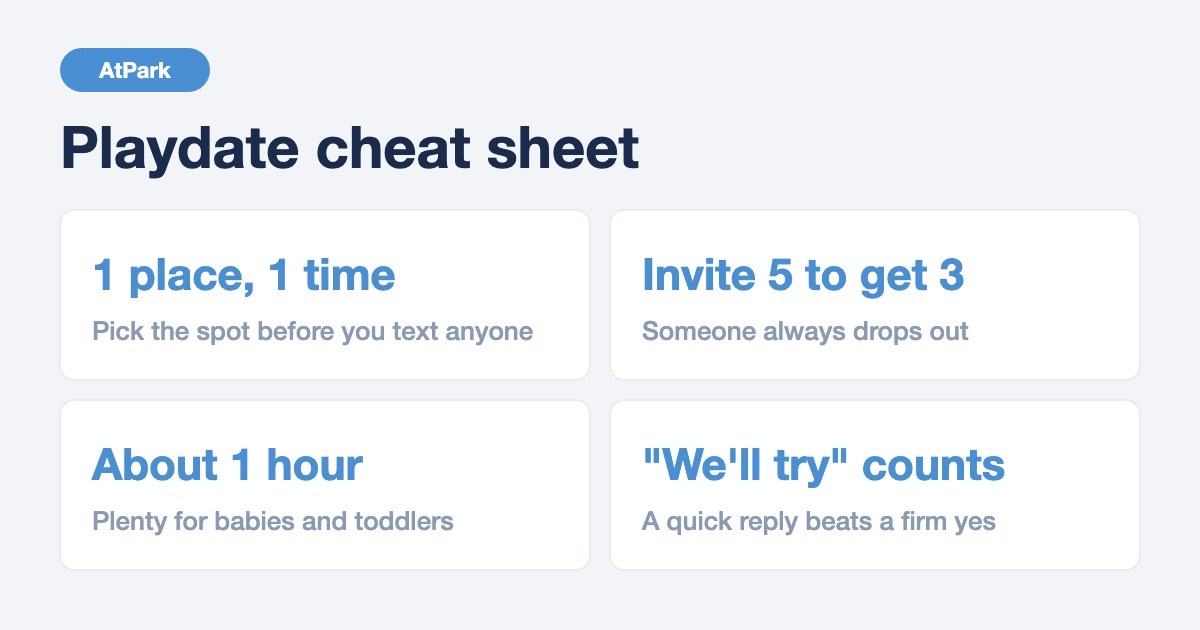
- Pick the spot first. “Want to get together sometime?” goes nowhere, but “We’re going to Riverside Park playground Thursday at 10” gets answers.
- Pick a time that fits naps. Mid-morning (9:30 to 11) works for most toddlers, while after school (3:30 to 5) works for bigger kids.
- Invite a few more families than you need. With little kids, someone always drops out, so invite five families when you want three there.
- Text each parent on their own. A group thread turns into forty messages and makes it awkward to say no. One-on-one invites get faster, more honest answers.
- Ask for a simple reply. You don’t need a firm yes, because “We’ll try” is enough to know roughly who’s coming.
- Send one reminder that morning. Include the exact spot: which entrance, which playground, where you’ll be sitting.
Most parents we talk to plan outings a few days ahead, and plans still change at the last minute. A diaper blowout or a skipped nap can cancel anything. Build that in and nobody feels bad.
Skip the group text
AtPark is a free app that sets up a playdate in one tap and texts each parent their own invite. They tap the link and RSVP. They don’t need to download anything.
Where should you have a playdate?
For a first playdate with a family you don’t know well, go somewhere public. A playground playdate is the easy pick: it’s free, nobody has to clean their house, and anyone can leave whenever they need to.
- Neighborhood park or playground: best all-around choice. Look for a fenced area if you have runners.
- Splash pad or pool: great in summer, but harder to chat while you watch kids near water.
- Library story time: built-in activity, good for shy kids and rainy days.
- Indoor playground or play cafe: good in winter. Check the price first so nobody is surprised.
- Your house: save it for families you already know. Put away the toys your kid won’t share.
What do you text to invite another family?
Keep it short and specific. Say where, when, and that there’s no pressure. Copy any of these:
- New friend: “Hi! It’s Sam, Ellie’s mom from story time. We’re heading to Riverside Park playground Thursday around 10 if you two want to join. No pressure either way!”
- Close friend, same day: “Park in an hour? We’ll be at the big slide.”
- A few families: “We’re doing the splash pad Saturday at 9:30. Come if you can, tell me yes or next time so I know who to look for.”
How do you find a playgroup near you?
If you’re searching “playgroup near me” because you don’t have parent friends yet, start where parents already are:
- Library story times and free parks and rec classes
- Local parent groups on Facebook or your neighborhood app
- Preschool, daycare, and church nursery pickup lines
- The same playground at the same time each week. You’ll start seeing the same faces.
Then do the brave part: ask one parent for their number and invite them to something specific. A playgroup is just a playdate that happened more than once.
What should you bring to a park playdate?
- Water and snacks, with extra to share (ask about allergies first)
- Sunscreen, wipes, and a change of clothes
- A ball, bubbles, or sidewalk chalk for when the slide gets old
- A blanket so the grown-ups have a home base
Park etiquette: the short version
- Reply to the invite, even if it’s a no. After all, hosts keep inviting people who answer.
- Sick kid stays home. Text as soon as you know.
- Watch your own kid. At a park playdate, each parent is on duty for their own.
- Leave on a good note. Give a five-minute warning and head out before the meltdown.
Make the next playdate a one-tap thing
Tap once in AtPark and your playdate is set with the place, time, and the parents you usually invite. Each one gets a text. You see who’s trying to make it, drop a pin on your exact bench, and share photos after. Free on iPhone and Android.
Parent FAQ
How long should a playdate last?
About an hour for babies and toddlers, and up to two hours for kids four and older. Shorter is better for a first playdate. End while everyone is still having fun.
How many kids should be at a playdate?
Two to four families is the sweet spot at a park. At home, keep it to one or two other kids until you know how they play together.
Do parents stay or drop off?
For kids under five, yes, parents usually stay. Around kindergarten, drop-off playdates start. If you’re not sure, ask in the invite: “Happy for you to stay or drop off, whatever works.”
How far ahead should you plan a playdate?
Two to four days ahead is plenty for most families. Same-day invites work well with close friends who live nearby. Either way, send a quick reminder that morning.
Is “playdate” one word or two?
Both are used. “Playdate” as one word is more common now, and “play date” means the same thing.
Planning something bigger than a playdate? Read how to host a potluck or how to host a casual dinner party.